Managing your money effectively starts with choosing the right bank account. Whether you’re a student saving pocket money, a professional managing daily expenses, or a business owner handling frequent transactions, the right account can save you money and help you achieve your financial goals. In India, the two primary bank account types are savings accounts and current accounts. This beginner-friendly guide, tailored for Indian consumers, explains their features, fees, and interest rates to help you select the best account. We’ll also show how toolsncalc.com can simplify your decision-making with free financial calculators.
Understanding Savings Accounts
 A savings account is designed for individuals who want to save money while earning interest. It’s perfect for personal use, such as building an emergency fund or saving for a big purchase like a phone or a vacation. Key features include:
- Interest Earnings: Banks pay interest on your balance, typically ranging from 2.5% to 7.75% per annum, depending on the bank and balance. For example, HDFC Bank offers 2.5%–3.5%, while small finance banks like Suryoday may offer up to 7.75%.
- Withdrawal Restrictions: Most banks limit free withdrawals (e.g., 4–6 per month) to encourage saving. Additional withdrawals may incur fees.
- Minimum Balance: Some accounts require a minimum balance (₹5,000–₹10,000) to avoid fees, but zero-balance options are available from banks like IDFC FIRST Bank.
- Additional Features: Debit cards, online banking, mobile apps, and UPI for easy payments.
Real-Life Scenario: Amit, a college student in Mumbai, opens a zero-balance savings account with Axis Bank to save his monthly pocket money of ₹5,000. Using toolsncalc.com’s savings calculator, he calculates that at 3% interest, his savings could grow to ₹5,150 in a year, helping him buy a new laptop.
Understanding Current Accounts
 A current account is tailored for businesses, entrepreneurs, or individuals with high transaction volumes, such as shop owners or freelancers. These accounts prioritize flexibility over interest earnings. Key features include:
- No Interest: Current accounts do not earn interest, focusing instead on transaction capabilities.
- Unlimited Transactions: Ideal for frequent deposits and withdrawals, with no cap on transactions.
- Overdraft Facility: Allows you to withdraw more than your balance, subject to bank approval and fees.
- Higher Minimum Balance: Typically requires ₹10,000–₹25,000 to avoid fees, higher than savings accounts.
Real-Life Scenario: Priya, who runs a small clothing store in Delhi, uses a current account with ICICI Bank to manage daily sales and supplier payments. The overdraft facility helps her cover expenses during slow months, and she uses toolsncalc.com’s loan calculator to estimate overdraft costs.
Comparing Fees and Interest Rates
Understanding fees and interest rates is crucial to avoid unexpected costs and maximize benefits.
Savings Accounts
- Fees:
- Minimum Balance Fees: Charged if your balance falls below the required amount (e.g., ₹500–₹1,000 at SBI if below ₹3,000 in urban areas).
- ATM Fees: Free for a limited number of transactions (e.g., 5 per month), then ₹10–₹20 per transaction.
- Service Charges: For cheque books, demand drafts, or additional services.
- Some banks, like IDFC FIRST Bank, offer zero-fee banking, waiving charges for ATM withdrawals, NEFT, and RTGS.
- Interest Rates:
- ICICI Bank: 2.5% p.a.
- HDFC Bank: 2.5%–3.5% p.a.
- Suryoday Small Finance Bank: Up to 7.75% p.a. for higher balances.
- Interest is calculated daily and credited quarterly or semi-annually.
Current Accounts
- Fees:
- Minimum Balance Fees: Higher than savings accounts (e.g., ₹10,000 at HDFC Bank).
- Transaction Fees: For services like demand drafts or exceeding free transaction limits.
- Overdraft Fees: Charged if you use the overdraft facility, based on the borrowed amount and duration.
- No Interest: Current accounts focus on transaction flexibility rather than earnings.
Comparison Table
| Feature |
Savings Account |
Current Account |
| Purpose |
Personal savings |
Business transactions |
| Interest |
2.5%–7.75% p.a. |
None |
| Transactions |
Limited (4–6 free/month) |
Unlimited |
| Minimum Balance |
₹0–₹10,000 |
₹10,000–₹25,000 |
| Overdraft |
Rarely available |
Common |
| Common Fees |
Minimum balance, ATM |
Minimum balance, transaction |
How to Choose the Right Account
To pick the best bank account, consider these factors:
- Purpose: Choose a savings account for personal savings or a current account for business transactions. For example, a salaried employee might prefer a savings account, while a shop owner needs a current account.
- Fees: Look for low or zero-fee accounts. Zero-balance savings accounts from banks like Axis or IDFC FIRST Bank are ideal for students or low-income individuals.
- Interest Rates: For savings accounts, compare rates across banks. Small finance banks often offer higher rates but may have fewer branches.
- Accessibility: Ensure the bank has a wide ATM network and robust mobile banking apps, like SBI’s YONO or HDFC’s NetBanking.
- Additional Services: Check for perks like free debit cards, UPI integration, or overdraft facilities for current accounts.
Real-Life Scenario: Raj, a freelancer in Bangalore, needs both personal and business accounts. He opens a zero-balance savings account with DBS Bank for personal savings, earning 5.5% interest, and a current account with Kotak Bank for client payments. Using toolsncalc.com’s savings calculator, he projects his savings growth, and the loan calculator helps him assess overdraft costs.
Using Tools to Make Decisions
Financial calculators can simplify your decision-making process. At toolsncalc.com, you can:
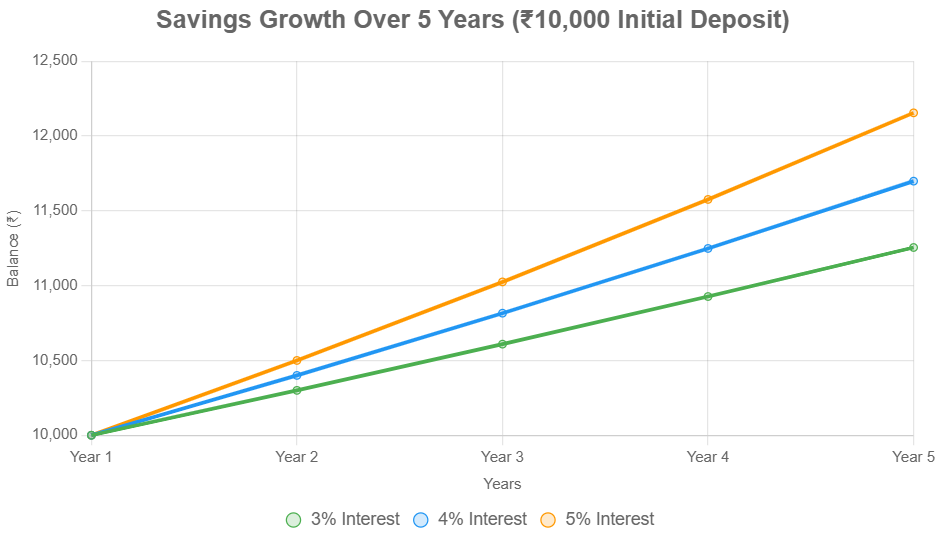
- Use the savings calculator to estimate how your savings will grow with different interest rates.
- Explore the loan calculator to understand overdraft or loan costs for current accounts.
- Compare account options by inputting fees and balances to find the most cost-effective choice.
For more insights, read our articles on What is Money? and Banks Explained to deepen your financial knowledge.
Savings Growth Over 5 Years
Conclusion
Choosing the right bank account in India depends on your financial needs—whether saving for the future or managing business transactions. Savings accounts offer interest and flexibility for personal use, while current accounts provide unlimited transactions for businesses. By comparing fees, interest rates, and services, you can find the perfect account. Visit toolsncalc.com to use free calculators and make informed financial decisions, ensuring your money works for you.






Comments
Please login to post a comment.