Compound interest is often called the "eighth wonder of the world" by investors like Warren Buffett, and in India, it's a powerful tool for growing your savings amid rising inflation (around 5% in 2025). With banks like HDFC and SBI offering rates from 2.5% to 7.75% on savings and fixed deposits, understanding compound interest can help you build wealth faster. This beginner-friendly guide explains the compound interest formula, its benefits—especially starting early—and how to use a calculator for real-life planning. We'll integrate examples using toolsncalc.com to show how small, consistent savings can lead to big results.
What is Compound Interest?
Compound interest is the interest earned on your initial principal plus the interest already accumulated, creating a snowball effect. Unlike simple interest, which is calculated only on the original amount, compound interest grows exponentially over time. In India, most savings accounts and fixed deposits (FDs) use compounding—typically quarterly or annually—regulated by the Reserve Bank of India (RBI).
For example, if you deposit ₹10,000 in an SBI savings account at 3% interest compounded annually, after one year, you earn ₹300, making your balance ₹10,300. In the second year, interest is calculated on ₹10,300, earning ₹309, and so on. This "interest on interest" is why compounding is ideal for long-term savings.
The Compound Interest Formula
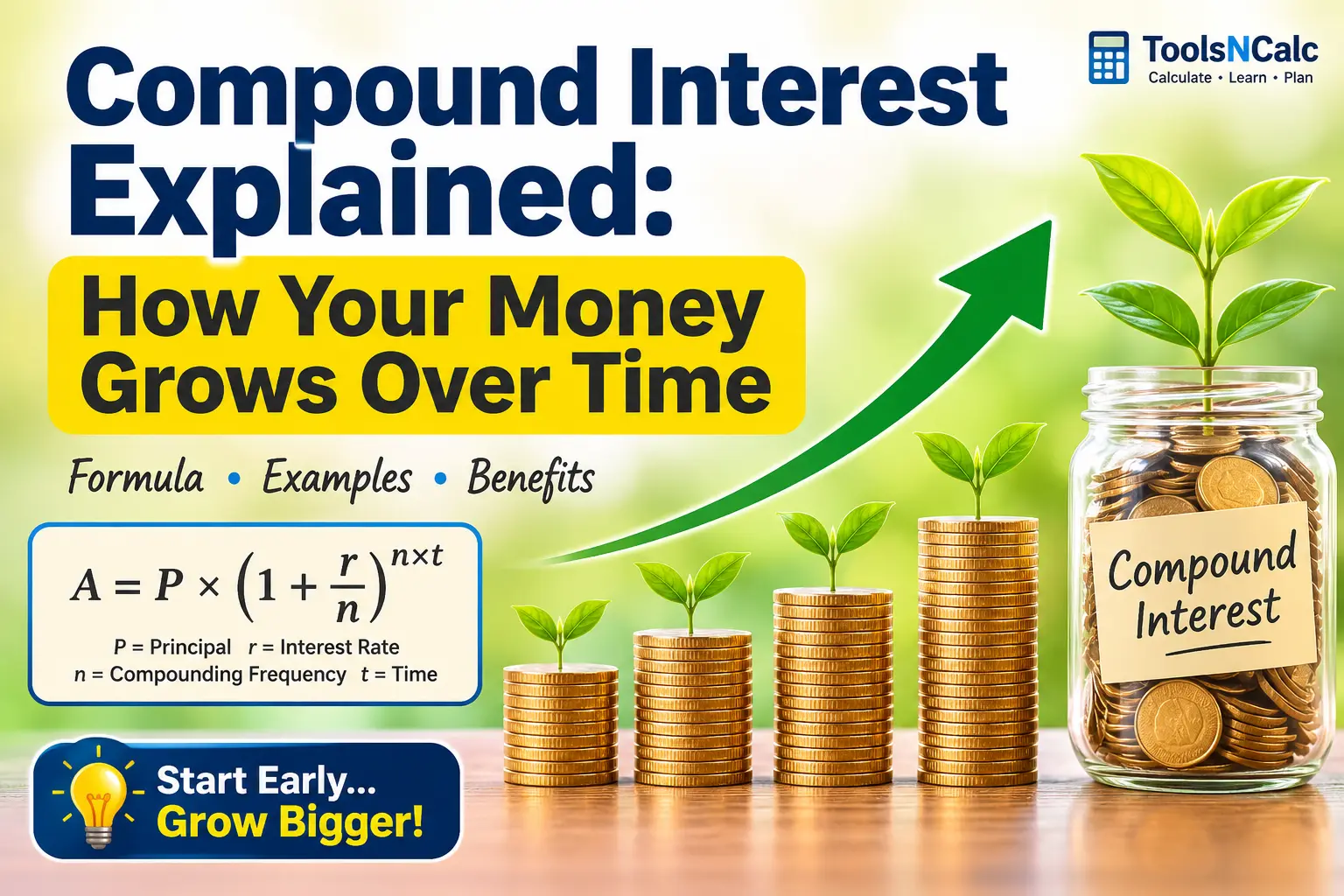
The standard formula for compound interest is:
A = P (1 + r/n)(nt)
- A: Total amount after time t
- P: Principal (initial deposit)
- r: Annual interest rate (as a decimal, e.g., 5% = 0.05)
- n: Number of times interest is compounded per year (e.g., 4 for quarterly)
- t: Time in years
Let's calculate manually: Suppose P = ₹10,000, r = 0.05 (5%), n = 1 (annually), t = 5 years.
A = 10,000 (1 + 0.05/1)(1×5) = 10,000 × (1.05)5 = ₹12,762.82
You earn ₹2,762.82 in interest—more than simple interest (₹2,500) due to compounding.
Use toolsncalc.com’s compound interest calculator to plug in your numbers and see instant results, avoiding manual math errors.
Benefits of Early Saving with Compound Interest
Starting early amplifies compound interest's power, as time allows more compounding cycles. In India, where retirement planning is crucial amid longer lifespans, early saving can turn modest deposits into substantial sums. The "rule of 72" estimates doubling time: Divide 72 by the rate (e.g., at 6%, money doubles in 12 years).
Real-Life Scenario 1: The Power of Time: Amit, a 25-year-old IT professional in Bangalore, starts saving ₹5,000 monthly in an HDFC FD at 6% compounded quarterly. By age 60 (35 years), his savings grow to over ₹60 lakh. If he starts at 35 (25 years), it's only ₹30 lakh—half, despite saving for 10 fewer years! Use toolsncalc.com’s savings calculator to model your timeline.
Real-Life Scenario 2: Emergency Fund Growth: Priya, a teacher in Delhi, deposits ₹50,000 in an SBI savings account at 3% compounded quarterly. After 10 years, it grows to ₹67,196. Starting 5 years later? Only ₹57,665. Early saving provides a bigger safety net for unexpected expenses like medical bills.
A Calculator Guide to Compound Interest
Manual calculations are useful, but online tools make it effortless. At toolsncalc.com, the compound interest calculator lets you input P, r, n, and t for instant results.
Step-by-Step Guide
- Enter Principal (e.g., ₹10,000).
- Input Rate (e.g., 5%).
- Choose Compounding Frequency (e.g., quarterly = 4).
- Set Time (e.g., 5 years).
- Click Calculate to see total amount, interest earned, and growth chart.
For loans, use toolsncalc.com’s loan calculator to see how compounding increases EMIs.
Real-Life Scenario 3: FD Investment: Raj invests ₹1 lakh in a Suryoday FD at 7.75% compounded quarterly for 5 years. The calculator shows it grows to ₹1,46,000—₹46,000 in interest. Without compounding, it'd be less.
Tips for Maximizing Savings in India
- Start Small, Early: Even ₹1,000 monthly at 6% over 30 years grows to ₹10 lakh via compounding.
- Choose High-Rate Accounts: Opt for small finance banks (up to 7.75%) or FDs for better returns.
- Reinvest Interest: Let compounding work by not withdrawing earnings.
- Monitor RBI Rates: Lower repo rates mean cheaper loans but lower savings yields—adjust accordingly.
- Explore related reads: Savings Accounts in India or Interest Rates Demystified.
Conclusion
Maximizing savings with compound interest in India requires understanding the formula A = P(1 + r/n)^(nt) and starting early to leverage time's power. With real examples from Indian banks, it's clear how compounding turns modest savings into significant wealth. Use toolsncalc.com’s compound interest calculator to plan your financial future today—your future self will thank you.
References



























Comments
Please login to post a comment.