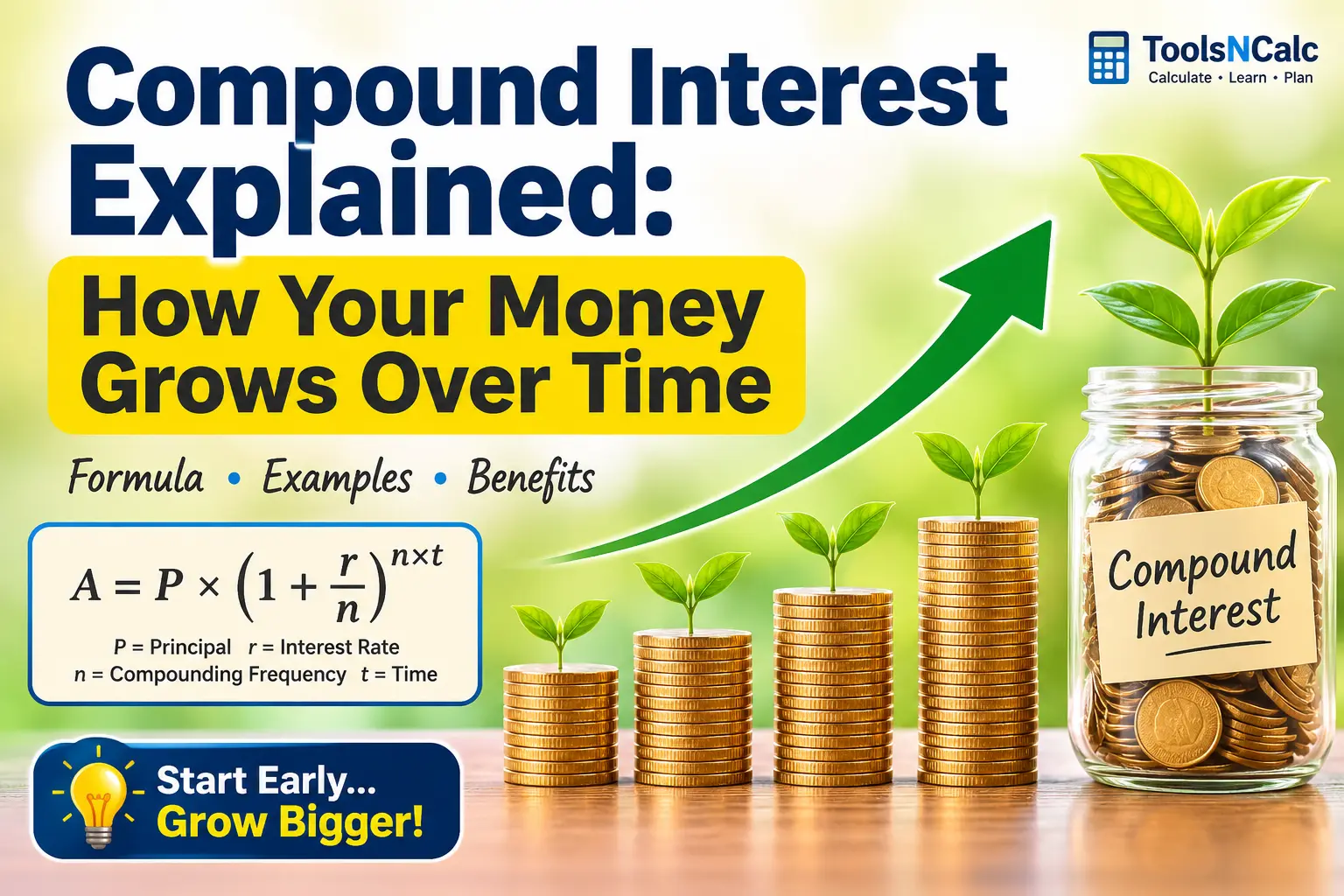
Compound Interest Explained: How Your Money Grows Over Time
Compound interest is interest earned on both your original investment and the interest accumulated over time. Unlike simple interest, which is calculated only on the initial amount, compound interest allows your money to potentially grow faster as interest is added back to your balance and earns further interest.
Understanding compound interest can help you make better decisions about savings, fixed deposits, investments, and long-term financial goals.
For example, if you invest ₹50,000 at an illustrative annual interest rate of 8%, compounded yearly, your investment could grow to approximately ₹1,07,946 after 10 years—before taxes, fees, or any other adjustments. You would earn around ₹57,946 in interest.
This guide explains what compound interest is, how it works, how to calculate it, and how you can estimate your own results using a compound interest calculator.
What Is Compound Interest?
Compound interest is often described as “interest on interest.”
When you earn interest on an investment or savings balance, that interest may be added to your original principal. In the next compounding period, interest is calculated on the new, larger balance.
This process repeats over time.
For example, suppose you deposit ₹10,000 into an account earning 10% interest annually, with interest compounded once per year.
| Year |
Starting Balance |
Interest Earned |
Ending Balance |
| 1 |
₹10,000 |
₹1,000 |
₹11,000 |
| 2 |
₹11,000 |
₹1,100 |
₹12,100 |
| 3 |
₹12,100 |
₹1,210 |
₹13,310 |
| 4 |
₹13,310 |
₹1,331 |
₹14,641 |
| 5 |
₹14,641 |
₹1,464.10 |
₹16,105.10 |
Notice how the interest earned increases each year. This happens because the interest is calculated on the growing balance rather than only on the original ₹10,000.
The example assumes a constant 10% annual rate, annual compounding, and no deposits or withdrawals.
How Compound Interest Works
The compounding process has three basic steps:
- You deposit or invest an initial amount, called the principal.
- Interest is calculated and added to the balance.
- Future interest is calculated on the updated balance.
The cycle continues for as long as the money remains invested and the interest is reinvested.
A simple example
Imagine investing ₹20,000 at an annual interest rate of 5%, compounded annually.
- After the first year, you earn ₹1,000.
- Your balance becomes ₹21,000.
- During the second year, 5% interest is calculated on ₹21,000.
- You earn ₹1,050 in the second year.
Your balance after two years becomes ₹22,050.
The extra ₹50 earned in the second year is interest on the interest from the first year.
This is the fundamental principle behind compound interest.
Compound Interest Formula
The compound interest formula helps calculate the future value of money when interest is added to the balance at regular intervals.
Compound interest formula with example
For interest compounded several times per year, the formula is:
A = P × (1 + r/n)^(n × t)
Where:
- A = Final amount, including principal and interest
- P = Initial principal amount
- r = Annual interest rate expressed as a decimal
- n = Number of compounding periods per year
- t = Investment duration in years
To calculate the compound interest earned:
Compound Interest = A − P
For example, an annual interest rate of 8% should be written as 0.08 in the formula.
Example: Calculate compound interest on ₹50,000
Suppose you invest ₹50,000 for 10 years at an annual interest rate of 8%, compounded annually.
The values are:
- Principal: ₹50,000
- Annual interest rate: 8% or 0.08
- Compounding frequency: 1 time per year
- Duration: 10 years
Using the formula:
A = 50,000 × (1 + 0.08/1)^(1 × 10)
A = 50,000 × (1.08)^10
Final amount ≈ ₹1,07,946.25
The compound interest earned is:
₹1,07,946.25 − ₹50,000 = ₹57,946.25
This is an illustrative calculation. Actual savings or investment returns depend on the financial product, its terms, applicable taxes, fees, and whether the rate remains constant.
Compound Interest vs Simple Interest
Simple interest and compound interest both calculate returns on money, but they differ in how interest is calculated.
With simple interest, the interest is always calculated on the original principal.
With compound interest, interest is calculated on the principal plus accumulated interest.
| Feature |
Simple Interest |
Compound Interest |
| Interest calculated on |
Original principal |
Principal plus accumulated interest |
| Interest amount each period |
Usually constant at a fixed rate |
Usually increases as the balance grows |
| Growth pattern |
Linear |
Compounding growth |
| Effect of time |
Interest increases proportionally with time |
Growth can accelerate over time |
| Reinvestment of interest |
Not included in the basic model |
Included |
Example: ₹50,000 at 8% for 10 years
Assume both calculations use the same principal, rate, and duration.
Simple interest:
Interest = Principal × Rate × Time
Interest = ₹50,000 × 0.08 × 10
Interest = ₹40,000
Final amount = ₹90,000
Compound interest, compounded annually:
Final amount ≈ ₹1,07,946.25
Interest earned ≈ ₹57,946.25
Under these assumptions, compound interest produces a larger final amount because previously earned interest also earns interest.
The comparison assumes the same rate and that all compound interest is reinvested.
How Money Grows with Compound Interest Over Time
One of the most important factors in compound interest is time.
When interest is reinvested, the balance can grow gradually at first and then more noticeably over longer periods.
Consider an initial investment of ₹50,000 earning a hypothetical 8% annual return, compounded annually.
| Investment Duration |
Approximate Final Amount |
Approximate Interest Earned |
| 5 years |
₹73,466 |
₹23,466 |
| 10 years |
₹1,07,946 |
₹57,946 |
| 15 years |
₹1,58,608 |
₹1,08,608 |
| 20 years |
₹2,33,048 |
₹1,83,048 |
| 25 years |
₹3,42,425 |
₹2,92,425 |
These figures assume a fixed 8% annual rate, annual compounding, no additional contributions, and no withdrawals. They are mathematical illustrations—not forecasts or guaranteed investment returns.
The example shows why time can make a substantial difference to compound growth.
Why starting earlier can matter
Starting earlier can give your money more time to compound.
For example, someone who begins saving at age 25 may have more years for growth than someone who starts at age 35, even if both invest the same initial amount.
However, starting early does not guarantee a better investment outcome. The amount invested, rate of return, costs, risk, and consistency also matter.
Factors That Affect Compound Interest
Several factors determine how much your money may grow.
1. Initial principal
The principal is the amount you start with.
A larger principal generally produces more interest when the rate, duration, and compounding frequency are the same.
2. Interest rate
The interest rate determines how much interest is earned during each compounding period.
A higher rate increases the mathematical growth of the balance, but higher potential returns in investments may involve greater risk.
3. Investment duration
The longer money remains invested and compounds, the greater the potential effect of compounding.
Time is particularly important when interest is reinvested.
4. Compounding frequency
Interest can be compounded annually, semi-annually, quarterly, monthly, or daily, depending on the financial product.
For the same positive nominal annual rate and otherwise identical assumptions, more frequent compounding generally produces a slightly higher amount.
The difference depends on the rate and frequency. Actual financial products may use different calculation and crediting rules.
5. Additional contributions
Adding money regularly can increase the balance available to earn interest or returns.
However, a calculation involving monthly deposits is different from a calculation involving only an initial lump sum. The timing of each contribution affects the final amount.
What Is the Difference Between Annual, Quarterly, and Monthly Compounding?
Compounding frequency refers to how often interest is added to the balance.
| Compounding Frequency |
Number of Periods Per Year |
| Annually |
1 |
| Semi-annually |
2 |
| Quarterly |
4 |
| Monthly |
12 |
| Daily |
Usually modeled as 365 |
Consider ₹50,000 at a nominal annual interest rate of 8% for 10 years.
If interest is compounded annually, the final amount is approximately ₹1,07,946.
If interest is compounded quarterly, the amount is approximately ₹1,10,402.
The quarterly result is higher under these assumptions because interest is added to the balance more frequently.
When comparing real financial products, check the actual terms. The advertised rate, interest calculation method, crediting frequency, and payout options can differ.
Compound Interest in India
Compound interest is relevant to many financial products available in India, including certain fixed deposits, recurring deposits, savings products, and investment calculations.
The actual interest calculation depends on the specific product and its terms.
Compound interest on savings
Some savings products credit interest periodically, and the credited interest may contribute to the balance used for future interest calculations.
Before choosing a savings account or deposit, review:
- The applicable interest rate
- How interest is calculated
- How frequently interest is credited
- Whether interest is paid out or reinvested
- Applicable fees and taxes
- Withdrawal restrictions or penalties
Do not assume that every account or deposit compounds in the same way.
Compound interest and fixed deposits
Fixed deposits may offer different interest payout and reinvestment options.
A cumulative deposit generally reinvests interest according to the product's terms, while a periodic payout deposit may pay interest out rather than reinvest it.
This difference can affect the amount accumulated over time.
Always review the bank's official deposit terms and maturity calculation before investing.
Compound interest and mutual fund investments
Mutual funds are not bank deposits and do not guarantee a fixed interest rate.
When investors talk about compounding in mutual funds, they often mean the reinvestment of gains and the potential growth of the investment's value over time.
Mutual fund returns fluctuate with market conditions and can be negative. A compound interest calculator using a fixed rate is only a mathematical illustration and does not predict mutual fund performance.
Benefits of Compound Interest
Compound interest can be useful for understanding long-term savings and investment growth.
Potential benefits include:
- Growth over time: Interest can accumulate on previously earned interest.
- Long-term savings: Compounding can help illustrate how savings may grow over many years.
- Encourages consistency: Regular saving and investing can increase the amount available to compound.
- Supports financial planning: Calculations can help estimate future values under different assumptions.
- Helps compare scenarios: You can compare different rates, amounts, and time periods.
Remember that compound interest is a mathematical mechanism, not a guarantee of profit. The actual outcome depends on the product and its terms.
How to Calculate Compound Interest Using ToolsNCalc
Calculating compound interest manually can become complicated when you change the rate, duration, or compounding frequency.
You can use the ToolsNCalc Compound Interest Calculator to estimate the future value of an amount.
Steps to use the calculator
- Open the ToolsNCalc Compound Interest Calculator.
- Enter your initial investment or principal amount.
- Enter the annual interest rate.
- Select the investment duration.
- Choose the compounding frequency supported by the calculator.
- Calculate the result.
- Review the estimated final amount and interest earned.
Try changing the duration or interest rate to see how the result changes.
For example, compare a 5-year period with a 15-year period using the same principal and interest rate.
This can help you understand the mathematical impact of time and compounding.
Calculator: Use the ToolsNCalc Compound Interest Calculator
Frequently Asked Questions
1. What is compound interest in simple words?
Compound interest means earning interest on your original money and on the interest that has already accumulated. As the balance grows, future interest may be calculated on a larger amount.
2. What is the compound interest formula?
For interest compounded several times per year:
A = P × (1 + r/n)^(n × t)
Here, A is the final amount, P is the principal, r is the annual interest rate as a decimal, n is the number of compounding periods per year, and t is the number of years.
Compound interest earned is the final amount minus the original principal.
3. Is compound interest better than simple interest?
At the same positive rate and over a period longer than one compounding interval, compound interest generally produces a larger amount when interest is reinvested. The actual comparison depends on the terms and assumptions.
4. How often can interest be compounded?
Depending on the financial product, interest may be compounded annually, semi-annually, quarterly, monthly, or daily. Always check the product's official terms.
5. Does compound interest guarantee investment returns?
No. Compound interest is a calculation method. It does not guarantee returns. Bank deposits, market-linked investments, and other financial products have different terms, risks, and return structures.
6. How can I calculate compound interest quickly?
Use a compound interest calculator. Enter the principal, interest rate, duration, and compounding frequency to estimate the final amount and interest earned.
Final Thoughts
Compound interest helps explain how money can grow when interest or investment gains are reinvested over time.
The main factors are the starting amount, rate of return, duration, and compounding frequency. Understanding these factors can help you compare savings scenarios and plan for long-term financial goals.
Use the ToolsNCalc Compound Interest Calculator to experiment with different amounts, rates, and durations. Remember that calculator results are estimates based on the inputs you provide and may not reflect actual financial product returns.
Disclaimer: This article is for educational and informational purposes only. It is not financial, investment, or tax advice. Actual returns depend on the financial product, applicable terms, taxes, fees, and market conditions.







Comments
Please login to post a comment.