Learn how to calculate profit and loss in the stock market using simple formulas and examples in rupees. Understand stock returns, average buying price, brokerage, STT, GST, CAGR, intraday trading, and Indian capital gains tax.
Official inflation figures show how prices change across a broad basket of goods and services, but your household may experience inflation differently. Learn how to calculate your personal inflation rate in India using your actual expenses, compare it with CPI, and understand what it means for your salary, savings, and investments.
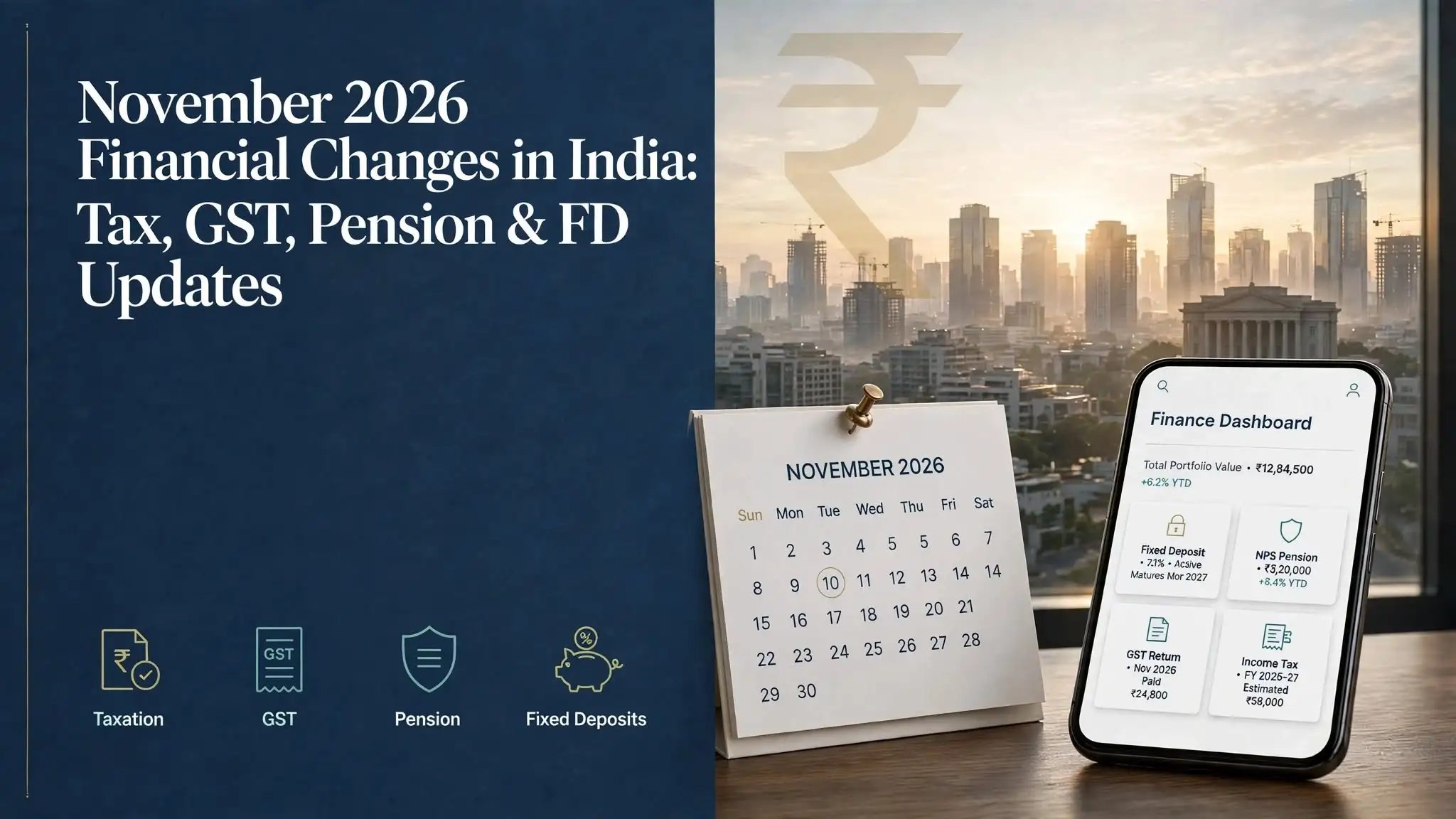
November 2026 brings important financial deadlines and regulatory updates for Indian taxpayers, pensioners, businesses and savers. Learn about the pension life certificate deadline, GST changes, income tax filing extensions, FD interest rates and banking updates—and understand which changes may affect you.
SIP and lumpsum investing are two ways to invest in mutual funds, but they suit different situations. Compare how they work, their risks, potential returns, rupee cost averaging, and when each approach may make sense for investors in India.
Discover how compound interest works and how it can help your money grow over time. Learn the compound interest formula, explore simple examples, understand the difference between compound and simple interest, and calculate potential savings growth using a compound interest calculator.
Guide to calculating potential stock returns using our investment tool: inputs like amount and rate, interpreting results for 2025. Beginner tips, scenarios, and charts to plan investments at toolsncalc.com.
Learn stocks for beginners in India: what stocks are, shares, dividends, risks, and how to buy. Simple explanations, real scenarios, and calculators to start investing in 2025 at toolsncalc.com.
Discover budgeting basics for beginners in India: step-by-step guide with 50/30/20 rule, tips, mistakes to avoid, and real examples to manage your money in 2025. Use toolsncalc.com calculators for effective financial planning.
Discover effective debt management strategies in India: snowball vs. avalanche methods, budgeting tips to pay off debt faster in 2025. Real scenarios, charts, and calculators for financial freedom at toolsncalc.com.
Discover credit cards in India: benefits like rewards, risks such as debt, and smart usage tips for beginners in 2025. Real scenarios and calculators to use credit wisely at toolsncalc.com.
India’s 2025 GST overhaul simplifies tax slabs to 5%, 18%, and 40%, effective September 22, 2025. Discover the extensive list of products and services that have become cheaper or costlier, impacting households, businesses, and the economy.
In 2025, India's GST undergoes a major revamp with slabs simplified to 5%, 18%, and 40%, making essentials cheaper from September 22. Explore rate changes, impacts, and tools in this guide.
Learn how to maximize savings with compound interest in India using the formula A = P(1 + r/n)^(nt). Discover early saving benefits, real examples, and a calculator guide for 2025 at toolsncalc.com.
Uncover interest rates in India: simple vs. compound explained, their impact on savings and loans, with tips for 2025. Use toolsncalc.com calculators to optimize your finances.
Discover the essentials of savings accounts in India for 2025, including types, interest rates, and tips to choose the best one for your needs. Learn how to grow your savings effectively with expert insights and tools from toolsncalc.com.
<p>Managing your money effectively starts with choosing the right bank account. Whether you’re a student saving pocket money, a professional managing daily expenses, or a business owner handling frequ
<p><b>London, July 7, 2025</b> – Hollywood’s newest power couple, Andrew Garfield and Monica Barbaro, made waves at Wimbledon’s seventh day on July 6, 2025, confirming their romance with a chic, coord
<p><b>Silverstone, UK – July 6, 2025</b> – Nico Hulkenberg achieved a historic milestone at the 2025 British Grand Prix, securing his first-ever Formula 1 podium after 239 race starts. The 37-year-old
<p>At ToolsnCalc.com, we take pride in providing accurate financial calculations. This article explains the mathematical formulas powering our most popular financial tools.</p>
<h3>Compound Interest
Savings Accounts in India: A Complete Guide for 2025
August 25, 2025 |
Personal Finance |
By ToolsnCalc Team
In India, a savings account is one of the most popular banking products, serving as a secure way to store money while earning interest. With over 1.5 billion bank accounts in the country as of 2025, savings accounts play a key role in financial inclusion, especially under schemes like Pradhan Mantri Jan Dhan Yojana. This article explores what a savings account is, its different types, criteria to choose the best one, and tips to maximize benefits. Whether you're a student, salaried professional, or senior citizen, understanding savings accounts can help you grow your money effectively. Use toolsncalc.com's savings calculator to estimate your earnings.
What is a Savings Account?
A savings account is a deposit account offered by banks where you can store money safely and earn interest on your balance. Unlike current accounts, which focus on transactions, savings accounts encourage saving by offering interest rates ranging from 2.5% to 8% per annum in 2025. Regulated by the Reserve Bank of India (RBI), these accounts are insured up to ₹5 lakh by the Deposit Insurance and Credit Guarantee Corporation (DICGC), providing security against bank failures.
Key Features and Benefits
Interest Earnings: Banks calculate interest daily or monthly and credit it quarterly or semi-annually. For example, ₹10,000 at 4% interest grows to ₹10,400 in a year.
Liquidity: Easy access via debit cards, ATMs, UPI, and online banking, with limited free withdrawals (typically 4–6 per month) to promote saving.
Safety: RBI oversight ensures your funds are protected.
Additional Perks: Many accounts include free debit cards, mobile banking, cashback on transactions, and linkages to investment options like mutual funds.
Tax Implications: Interest up to ₹10,000 is tax-free under Section 80TTA, but higher amounts are taxable.
Savings accounts are ideal for emergency funds or short-term goals, offering better returns than keeping cash at home while providing convenience.
Different Types of Savings Accounts in India
Indian banks offer various savings accounts to cater to diverse needs, promoting financial inclusion. As of 2025, there are six main types, each with unique features:
Regular Savings Account: For general public use, suitable for salaried individuals or homemakers. Features: Interest 2.5%–4%, minimum balance ₹5,000–₹10,000, debit card, online banking. Example: HDFC Bank Regular Savings Account (3%–3.5% interest).
Zero-Balance Savings Account (Basic Savings Bank Deposit - BSBD): For low-income groups, students, or rural users, no minimum balance required. Features: Interest 2.5%–4%, basic services like debit card and limited free withdrawals. Example: SBI BSBD Account, linked to Jan Dhan Yojana.
Women's Savings Account: Tailored for women to encourage financial independence. Features: Interest 2.5%–4%, perks like shopping discounts, lower fees, or free insurance. Example: ICICI Bank Advantage Woman Aura Savings Account.
Kids/Minor Savings Account: For children under 18, managed by guardians. Features: Zero/low minimum balance, interest 2.5%–4%, educational perks. Example: Axis Bank Future Stars Savings Account.
Salary Savings Account: For salaried employees, often tied to employer payroll. Features: Zero-balance options, interest 2.5%–4%, overdraft facilities. Example: Kotak Mahindra Bank My Salary Account.
Some banks also offer premium or NRI savings accounts, but these fall under specialized categories.
Criteria to Choose a Savings Account in India
Selecting the right savings account depends on your profile and goals. Here are key criteria to consider in 2025:
Interest Rate: Opt for higher rates (e.g., 7%+ from small finance banks) if you maintain larger balances. Compare compounded rates for real growth.
Minimum Balance Requirement: Choose zero-balance if you have irregular income; avoid penalties that can be ₹500–₹1,000 monthly.
Fees and Charges: Look for low ATM (beyond 5 free/month), transaction, or service fees. Zero-fee banking from IDFC FIRST is ideal.
Accessibility and Digital Features: Ensure wide ATM networks, robust apps (e.g., UPI, net banking), and easy account opening.
Additional Benefits: Perks like cashback, insurance, or rewards can add value, especially in women's or salary accounts.
Customer Service: Check for 24/7 support, multilingual options, and user reviews on responsiveness.
Security: RBI-regulated banks with DICGC insurance up to ₹5 lakh are safest. Look for fraud alerts and two-factor authentication.
Withdrawal Limits: Ensure sufficient free withdrawals (e.g., 5–10/month) and high daily ATM limits (₹40,000+).
Account Type Suitability: Match to your needs—e.g., senior accounts for retirees, kids' for minors.
Opening is simple and can be done online or in-branch:
Choose a bank and account type.
Submit KYC documents (Aadhaar, PAN, photo).
Fill the application form.
Make an initial deposit if required.
Activate with debit card/PIN.
Digital banks allow video KYC for quick setup.
Benefits of Savings Accounts
Earn passive income through interest.
Build financial discipline with withdrawal limits.
Access government schemes like Jan Dhan for subsidies.
Link to investments like mutual funds or fixed deposits.
Common FAQs
What is the best savings account in 2025? IDFC FIRST or Suryoday for high interest (7%+).
Is interest taxable? Yes, above ₹10,000 under Section 80TTA.
Can NRIs open savings accounts? Yes, via NRO/NRE accounts.
Conclusion
Savings accounts in India are essential for secure, interest-earning storage of money, with types catering to everyone from students to seniors. By evaluating interest rates, fees, and benefits, you can choose one that fits your lifestyle. For personalized calculations, try toolsncalc.com's savings calculator. Stay updated with RBI guidelines for the latest changes. Explore related articles like Banks Explained or What is Money? for more financial insights.







 A savings account is a deposit account offered by banks where you can store money safely and earn interest on your balance. Unlike current accounts, which focus on transactions, savings accounts encourage saving by offering interest rates ranging from 2.5% to 8% per annum in 2025. Regulated by the
Comments
Please login to post a comment.